

The Moment Collaboration Gets Real ( and Messy)
The "Honeymoon Phase" is a Trap
You know exactly what those first few partnership meetings feel like.
Every one is excited and on their absolute best behaviour. There is a lot of enthusiastic nodding. The air is thick with possibility. You look around the table and think, “Wow, we are really going to change things together.”
It feels easy. It feels promising.
But here is the hard truth: If your partnership stays in this polite, pleasant phase, it is doomed to fail.
If you want to create something real, the honeymoon has to end. And what comes next is going to feel like things are falling apart. Yet, it’s actually the moment partners start coming together.
The Moment the Vibe Shifts
There is a distinct moment in every serious collaboration where the temperature in the room drops.
The collective “We” suddenly fractures back into a room full of individual “Me’s.” You can see it happen. Someone start doing the mental math: “Wait a minute. If I commit my team’s time and money to this, I need to make sure my needs are met.”
Suddenly, the politeness evaporates. People stop nodding and start negotiating. The smooth sailing hits the rocks.
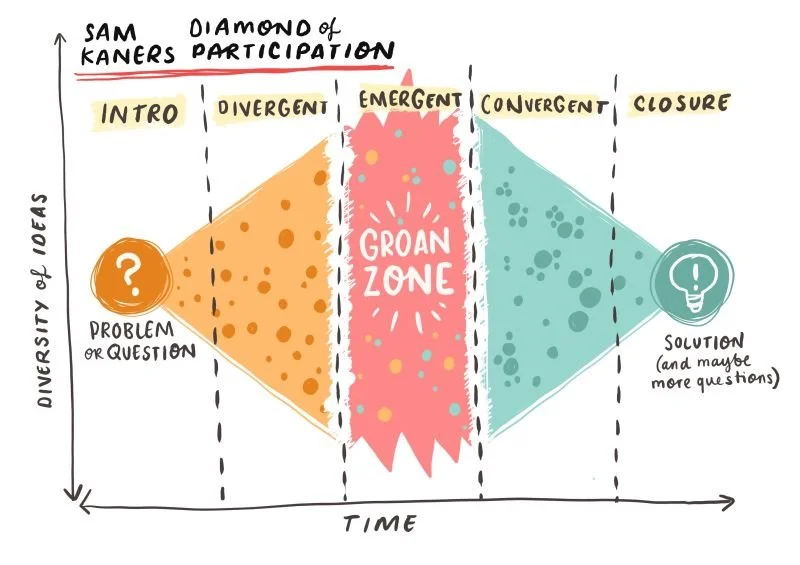
The Groan Zone
Facilitator Sam Kaner calls this The Groan Zone. It is that agonizing phase where different worldviews crash into each other. It feels chaotic. It feels tense. (Learn more at the Groan Zone blog.)
When this happens, many partners panic. They assume the collaboration is broken because the initial harmony is gone. They are wrong.
Self-Interest is Not Betrayal
If you want to be a better partner, you need to fundamentally change how you view self-interest.
We are often taught that collaboration requires self-sacrifice. We think that advocating for our own needs is “selfish” or goes against the spirit of the group.
But consider the alternative: If a partner doesn’t fight for what they need, they won’t stay at the table. A shared goal that doesn’t actually help the individual partners isn’t sustainable, it’s just a nice idea.
The shift from polite nodding to “Here is what I need” isn’t a betrayal of the collaboration; it is the fuel for it.
Real transformation doesn’t happen when we are just being nice to each other. It happens when we grapple with our differences. The Groan Zone is simply the sound of diversity finally being put on the table.
Stop Building "Safe" Spaces
We talk a lot about creating "safe spaces" in partnerships. But if a space is too safe, too comfortable, too polite, it usually lacks impact.

See Brave Spaces Blog
Don't build a safe space. Build a Brave Space. (Learn more at the Brave Space Blog)
A brave space is only "safe enough" for people to take risks. It is an environment where friction is expected. Trust isn’t built in the early days when everyone agrees on the vision. Trust is built in the Groan Zone, when you look a partner in the eye, disagree with them, and commit to figuring it out anyway.
How to Navigate the Mess
So, how do you lead when the politeness wears off and the real work begins?
1. Invite the "Me" into the "We": Don't wait for partners to get frustrated and demand things. Invite their self-interest early. Ask explicitly: "What does your organization need to get out of this to call it a win?" By engaging with their individual needs immediately, you validate them. You show them that their success is part of the collective success.
2. Be an Active Listener: When a partner stops being polite and starts being demanding, the room usually gets defensive. Resist that urge. When someone is digging their heels in, look beneath the surface. They aren't trying to sabotage the project; they are protecting something they value. Listen to the need behind the demand.
3. High-Five the Friction: When the groaning starts and the arguments begin, don't panic. Congratulate the room. Remind them: "This tension feels bad, but it’s good news. It means we are done with the superficial stuff and we are finally doing the real work."
The transition from polite thoughtfulness to assertive self-interest is bumpy. It’s uncomfortable. But it is the only doorway to a partnership that actually works.